
Ignorance might be bliss — but I've never been very good at looking away.
This little corner of the website is where I share the things that matter to me beyond work: photography, travel, life between two cities, and yes — animals. Because once you know, you can't unknow. And honestly, making kinder choices is rarely as hard as we tell ourselves it is. Swap the milk in your coffee for oat. Skip the meat one night a week. Choose the product that didn't cost something a suffering. None of it will single-handedly change the world — but none of it is nothing, either.
I'm not here to lecture. I'm just here to share what I've found, what I've read, and what keeps me choosing differently — one small, barely-inconvenient step at a time.

Articles

Every single day in the Netherlands, 1.5 million chickens, 45,000 pigs and 5,000 cows are killed for food. More than 1.7 million living beings — daily. In this column for De Correspondent, writer Simon van Teutem argues that this is not normal, and that the time for excuses is long past. The animals behind these numbers are not unfeeling machines: pigs are social, curious and highly intelligent; cows distinguish between individual humans; even chickens show genuine empathy. Yet the factory farming industry continues to treat them as if none of that is true.
What makes this piece particularly striking is its challenge to the idea that we simply don't know any better. The information is there — we just choose not to look. With nearly 1,000 mega-farms in the Netherlands, the country holds more livestock per square kilometre than anywhere else in the EU, with only 3.4% of animals raised organically. Van Teutem's argument is not that everyone must go vegan overnight, but that knowingly participating in unnecessary suffering — when alternatives exist — is something worth sitting with. Read the full column (in Dutch) here.
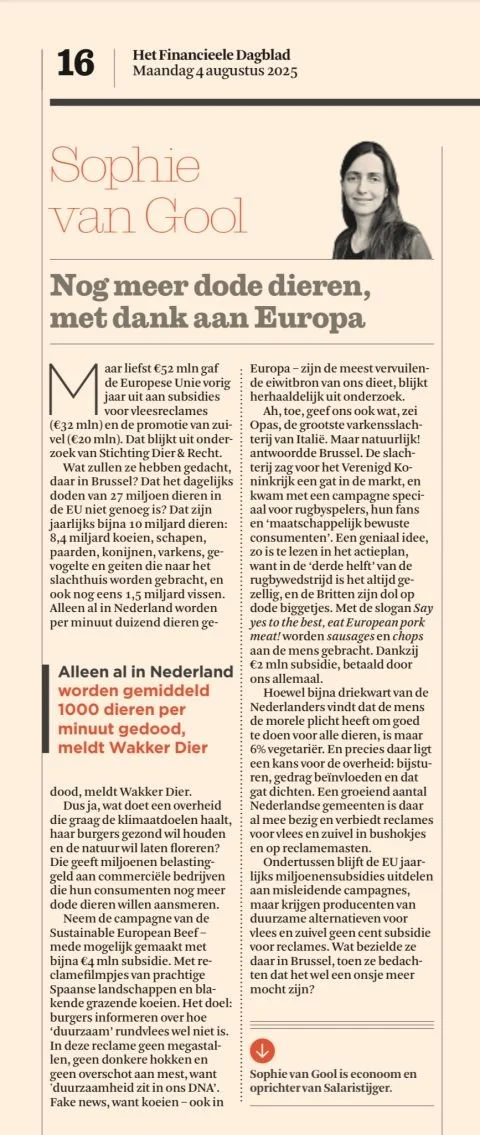
The European Union spent €52 million last year subsidising meat and dairy advertising — €32 million for meat promotions and €20 million for dairy, according to research by Stichting Dier & Recht. This while the EU already slaughters 27 million animals every single day. That adds up to nearly 10 billion animals per year: cows, sheep, horses, rabbits, pigs, poultry, goats — and another 1.5 billion fish. In the Netherlands alone, 1,000 animals are killed every minute, according to animal welfare organisation Wakker Dier.
In this sharp opinion piece for Het Financieele Dagblad, economist Sophie van Gool asks the obvious question: what exactly is a government doing when it hands millions in taxpayer money to commercial companies to sell people more dead animals — while simultaneously claiming to care about climate targets, public health, and nature? The EU's answer, it turns out, is a campaign budget and a rugby sponsorship.
Read the full article (in Dutch) in Het Financieele Dagblad, 4 August 2025.
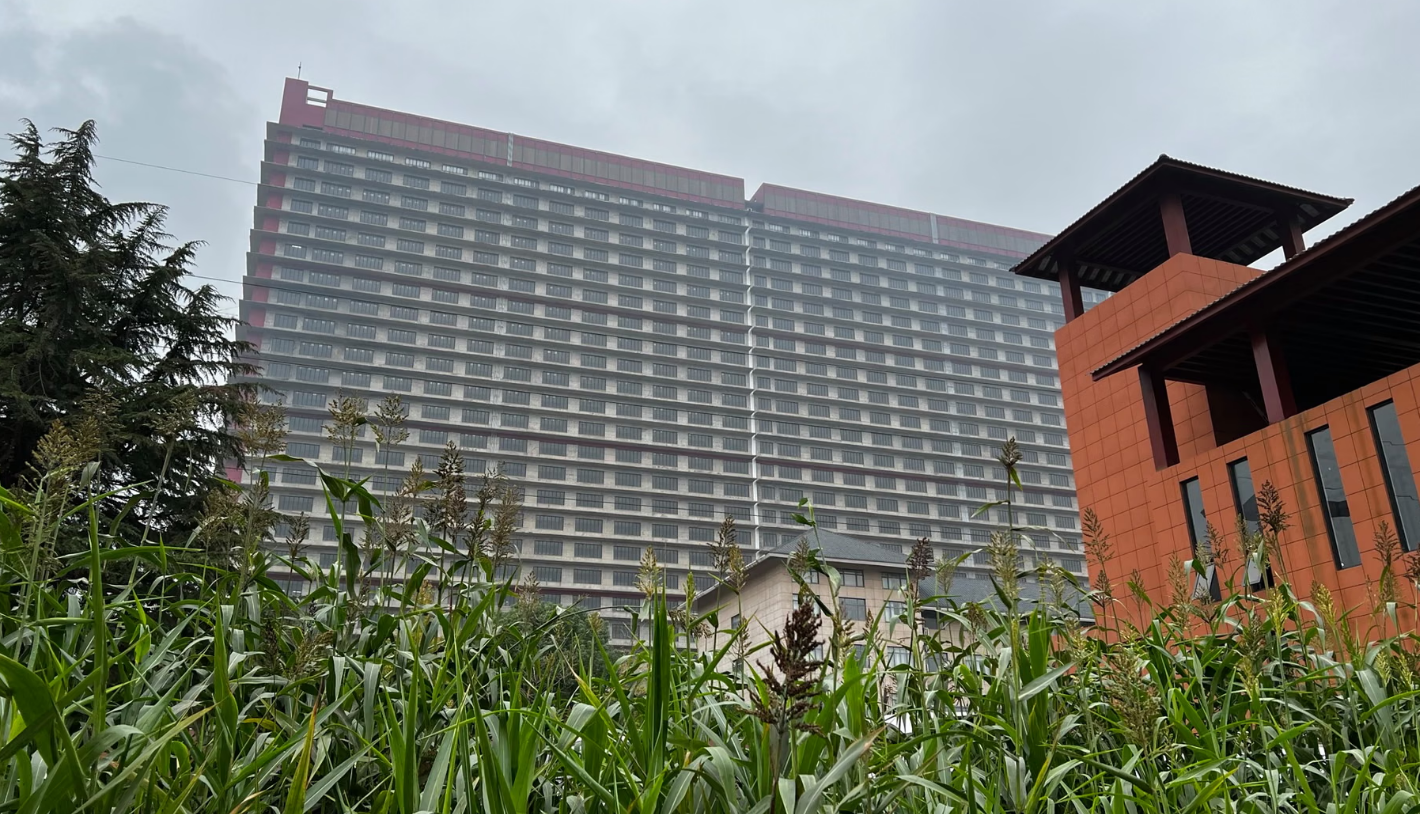
From the outside, it looks like an ordinary apartment building on the outskirts of Ezhou, China. On the inside, 650,000 pigs live out their short lives across 26 floors, never seeing daylight, never setting foot on soil. The facility — the largest single-building pig farm in the world — can slaughter 1.2 million animals per year. It was built by a cement company that pivoted to farming when construction profits dried up. China, which consumes around half of all the world's pork, now has an estimated 170 similar multi-storey farms in Guangdong province alone.
Experts have raised serious concerns beyond the obvious animal welfare questions. Scientists warn that concentrating hundreds of thousands of animals in one enclosed space creates ideal conditions for disease to mutate and spread — potentially to humans. The same logic that was meant to improve biosecurity, they argue, could instead produce the next pandemic. This is not a distant future scenario. It is already built, already running, and already being replicated.
And before we shake our heads from a comfortable distance — the Netherlands kills 1.5 million chickens, 45,000 pigs and 5,000 cows every single day. It holds more livestock per square kilometre than anywhere else in the European Union. Only 3.4% of Dutch animals are raised organically, making it one of the worst performers in the EU on that front. The buildings may look different. The scale may feel less dramatic. But the numbers don't lie — and looking away is just as easy from Amsterdam as it is from anywhere else.